
Exempt vs Non-Exempt Employees: A Complete Guide for Employers in India
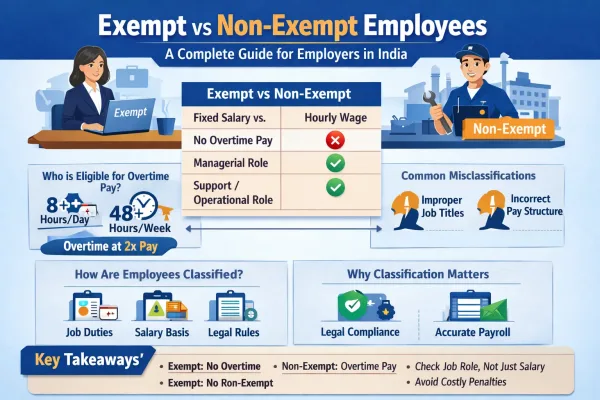
Exempt vs Non-Exempt Employees in India: Key Differences, Overtime Rules & Compliance Guide
Employee classification is a critical aspect of HR and labour law compliance. Misclassification can lead to legal penalties, employee disputes, and financial liabilities. Understanding the distinction between exempt and non-exempt employees is essential for businesses managing payroll, overtime, and statutory obligations.
This guide explains everything employers need to know in a clear and practical manner.
What Are Exempt Employees?
Exempt employees are those who are not entitled to overtime pay under applicable labour laws. These employees are typically:
- Paid a fixed salary
- Assigned managerial, administrative, or professional roles
- Given decision-making authority
Common Examples:
- Managers and team leaders
- HR heads
- Finance controllers
- Senior consultants
Their compensation structure already accounts for extended work hours, so overtime provisions do not apply.
What Are Non-Exempt Employees?
Non-exempt employees are eligible for overtime pay as
per labour laws. These employees are generally:
- Paid
on an hourly or wage basis - Engaged
in operational or execution roles - Required
to follow strict working hour limits
Common Examples:
- Clerks
and assistants - Factory
workers - Technicians
- Customer
support staff
If they work beyond prescribed hours, they must be compensated with overtime wages.
|
Basis |
Exempt Employees |
Non-Exempt Employees |
|
Overtime Eligibility |
Not eligible |
Eligible |
|
Salary Structure |
Fixed salary |
Hourly/Wage-based |
|
Job Role |
Managerial/Professional |
Operational/Support |
|
Working Hours |
Flexible |
Defined & regulated |
|
Legal Protection |
Limited (for overtime) |
Strong protection |
Who is Eligible for Overtime Pay?
Overtime eligibility depends on:
- Nature
of work - Designation
- Applicable
labour laws
In India, overtime provisions are governed under laws such
as:
- Factories
Act, 1948 - Shops
and Establishments Acts (state-specific) - Code
on Wages, 2019
General Rule:
Employees working beyond 8–9 hours per day or 48 hours per week are entitled to overtime pay, usually at twice the normal wage rate.
How Are Employees Classified?
Employee classification is determined based on:
1. Job Role and Responsibilities
- Decision-making
authority - Supervisory
duties
2. Salary Structure
- Fixed
salary vs hourly wages
3. Level of Independence
- Independent
roles are often exempt - Controlled
roles are non-exempt
4. Legal Framework
- Industry-specific
regulations - State
labour laws
Employers must assess all these factors before assigning classification.
Key Takeaways
- Employee classification directly impacts payroll, compliance, and legal risk
- Exempt employees are not eligible for overtime, while non-exempt employees are
- Classification must be based on job role, not just salary or designation
- Misclassification can lead to financial penalties and reputational damage
- Regular audits and expert consultation can help ensure compliance