
ESIC Medical Facilities Scheme for Other Beneficiaries, 2026: A New Step Towards Wider Healthcare Access
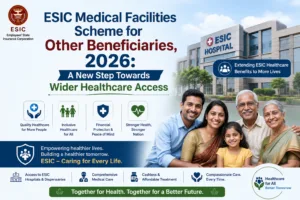
The Ministry of Labour and Employment has introduced the Other Beneficiaries and Members of their Families Medical Facilities Scheme, 2026 through Notification S.O. 2355(E) dated 8 May 2026. Issued under Section 44 of the Code on Social Security, 2020, the Scheme came into effect from the date of its publication in the Official Gazette.
The initiative marks a significant step towards maximizing the utilization of Employees’ State Insurance Corporation (ESIC) healthcare infrastructure while expanding access to quality medical services for beneficiaries covered under various Central Government welfare schemes.
Background
The Employees’ State Insurance Corporation operates an extensive network of hospitals, dispensaries, and medical institutions across India. While these facilities were established primarily to serve insured persons under the ESI Scheme, several hospitals in different regions continue to have spare capacity and remain under-utilized.
Recognizing this opportunity, the Government has launched the Medical Facilities Scheme, 2026, enabling eligible beneficiaries from other Central Government schemes and their family members to access treatment at selected ESIC hospitals. The move is expected to improve healthcare accessibility while ensuring optimal use of public healthcare infrastructure.
Applicability of the Scheme
The Scheme applies to:
- Other beneficiaries registered under schemes framed by the Central Government.
- Members of their families who meet the prescribed eligibility criteria.
Importantly, the Scheme is not intended for regular insured persons already covered under the Employees’ State Insurance Scheme. Instead, it creates a separate framework allowing additional categories of beneficiaries to avail healthcare services at designated ESIC facilities.
Registration Process
To receive medical treatment under the Scheme, beneficiaries must complete a registration process.
Applicants are required to:
- Submit the prescribed registration form electronically or through any other approved mode.
- Provide details of themselves and eligible family members.
- Produce a valid identity card issued by ESIC or any other applicable Central Government scheme.
The registration mechanism helps ensure that only eligible individuals and their dependents can access benefits under the Scheme.
Medical Benefits Available
Registered beneficiaries will be entitled to receive medical treatment and attendance from identified under-utilized ESIC hospitals.
The provision serves multiple objectives:
- Enhances healthcare access for beneficiaries of other government schemes.
- Improves utilization of ESIC medical infrastructure.
- Reduces pressure on other public healthcare institutions.
- Expands the reach of social security-linked healthcare services.
By leveraging existing infrastructure, the Government aims to create a more efficient and inclusive healthcare delivery system.
User Charges and Financial Provisions
Unlike regular ESIC medical benefits, beneficiaries under this Scheme will be required to pay user charges.
The rates will be notified by the Employees’ State Insurance Corporation in consultation with the Central Government.
A noteworthy feature of the Scheme is that the user charges collected will be treated as contributions and credited to the Employees’ State Insurance Fund. This ensures financial sustainability while enabling wider access to ESIC healthcare facilities.
Record-Keeping and Compliance Requirements
The Scheme places a strong emphasis on transparency and accountability.
ESIC hospitals providing treatment under the Scheme must:
- Maintain separate electronic registers for beneficiaries covered under the Scheme.
- Keep distinct treatment records.
- Record and track all user charges collected.
- Ensure proper segregation of records from those maintained for regular ESIC beneficiaries.
These compliance measures support effective monitoring, audit readiness, and efficient administration of the Scheme.
Key Implications for Employers and Compliance Professionals
Employers should understand that this Scheme does not alter existing ESIC compliance obligations applicable to eligible employees under the ESI framework or the Code on Social Security, 2020.
Key points include:
- Regular ESIC registration and contribution requirements remain unchanged.
- The Scheme is separate from the standard ESIC coverage available to insured employees.
- It primarily focuses on extending healthcare services to beneficiaries of other Central Government schemes.
- It reflects the Government’s broader objective of expanding social security benefits through existing healthcare infrastructure.
For HR professionals, payroll managers, and labour law compliance practitioners, it is important to distinguish between regular ESIC coverage and benefits available under this newly introduced Scheme.
Benefits of the Scheme
The Medical Facilities Scheme, 2026 offers several advantages:
Better Utilization of Existing Infrastructure
Under-utilized ESIC hospitals can now serve a wider beneficiary base, improving efficiency and public resource utilization.
Expanded Healthcare Access
Beneficiaries of various Central Government schemes gain access to established medical facilities and specialized healthcare services.
Financial Sustainability
The user charge model supports the ESIC Fund while allowing beneficiaries to access quality medical care.
Strengthened Social Security Framework
The Scheme aligns with the Government’s vision of broadening social security coverage and healthcare accessibility across India.
Conclusion
The Other Beneficiaries and Members of their Families Medical Facilities Scheme, 2026 represents a progressive policy initiative aimed at expanding healthcare access while ensuring optimum utilization of ESIC medical infrastructure.
By allowing registered beneficiaries under other Central Government schemes to avail treatment from under-utilized ESIC hospitals, the Government has created a balanced framework that combines accessibility, accountability, and financial sustainability. While the Scheme does not impact existing employer obligations under ESIC, it reflects a broader commitment to strengthening India’s social security and healthcare ecosystem.
As the implementation progresses, the Scheme is expected to play an important role in extending quality healthcare services to a larger section of society while maximizing the value of public healthcare investments.