
Mandatory ESIC Registration for Educational Institutions Under the Code on Social Security, 2020
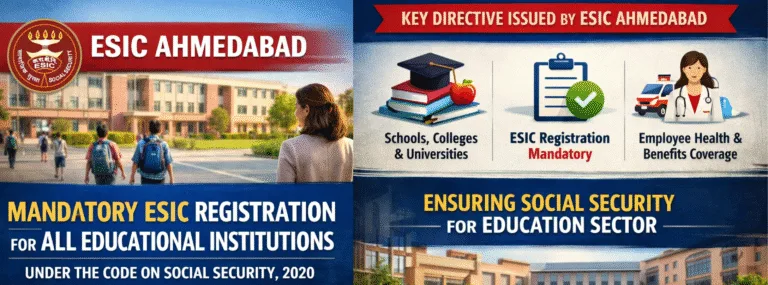
ESIC Ahmedabad Issues Binding Compliance Directive
Introduction: A Landmark Shift in Social Security Coverage
The implementation of the Code on Social Security, 2020 (CoSS 2020) with effect from 21 November 2025 represents a decisive step in India’s labour law reforms. By consolidating and modernising multiple welfare legislations, the Code seeks to ensure uniform social security coverage across sectors, with special emphasis on previously under-covered segments such as educational institutions.
In line with the nationwide enforcement of CoSS 2020, the Regional Office of ESIC, Ahmedabad has issued a formal directive mandating immediate ESIC registration and employee enrolment for all educational institutions, including aided, unaided, private schools, colleges, training centres, and affiliated bodies.
This directive significantly expands compliance obligations for the education sector and leaves little scope for deferment.
1. ESIC Coverage Becomes Mandatory for the Education Sector
One of the most impactful changes under CoSS 2020 is the expanded definition of “establishment.” Educational institutions—earlier subject to inconsistent coverage—are now explicitly brought within the statutory framework of ESIC.
Key Implications:
All eligible teaching and non-teaching staff must be covered
ESIC registration becomes a legal obligation, not a choice
Employees gain access to medical care, maternity benefits, disability compensation, and dependent benefits
This reform places educational institutions on equal footing with other industries in terms of employee welfare and statutory responsibility.
2. Mandatory Compliance Requirements for Educational Institutions
The ESIC Ahmedabad directive outlines three immediate and non-negotiable actions:
a) ESIC Registration of the Institution
Every educational establishment employing eligible persons must register under ESIC without delay.
b) Enrolment of All Eligible Employees
Both academic and administrative staff falling within the prescribed wage threshold must be enrolled to ensure universal statutory coverage.
c) Timely Monthly Contribution Payments
Institutions must ensure regular and timely deposit of ESIC contributions to enable uninterrupted access to benefits, including:
Medical treatment
Sickness and disablement benefits
Maternity benefits
Dependent benefits
Funeral expenses
Delayed payments may attract interest, damages, and penal consequences.
3. Applicability: Who Must Comply?
The directive applies broadly to all forms of educational establishments, including:
Aided schools and colleges
Unaided and private institutions
Recognised and affiliated educational bodies
Training centres, academies, and skill institutes
Any establishment employing eligible persons
Educational authorities have been instructed to circulate the directive widely and maintain updated records of covered institutions.
4. Why Immediate ESIC Compliance Is Critical
Educational institutions must treat ESIC compliance as a top-priority statutory requirement due to the following reasons:
Legal Mandate: ESIC coverage is compulsory under CoSS 2020
Financial Exposure: Delays may result in retrospective contribution demands, interest, and damages
Regulatory Action: Non-compliance invites inspections, audits, and legal proceedings
Employee Welfare: Timely enrolment ensures access to essential social security benefits
Institutional Credibility: Compliance reflects ethical governance and workforce responsibility
Early action significantly reduces legal and financial risk.
5. Practical Impact on Schools and Colleges
| Compliance Area | Impact Under CoSS 2020 |
|---|---|
| Coverage | Mandatory for all institutions employing eligible persons |
| Cost Obligations | Employer and employee ESIC contributions |
| Administration | Monthly filings, wage disclosures, record maintenance |
| Employee Benefits | Medical, maternity, disability, and dependent support |
| Non-Compliance Risks | Interest, penalties, inspections, and backdated liabilities |
Institutions must therefore strengthen HR, payroll, and compliance systems to meet ongoing obligations.
6. CPS LLp Expert Advisory
The inclusion of educational institutions under ESIC marks a clear policy shift towards universal social security coverage. Institutions that delay compliance expose themselves to unnecessary regulatory and financial risk.
CPS LLP recommends the following action plan:
Conduct an immediate ESIC applicability and wage assessment
Complete ESIC registration on the official portal
Enrol all eligible employees without exception
Train HR and payroll teams on contribution and filing procedures
Maintain documentation for audit and inspection readiness
Corporate Personnel Services (CPS) is actively assisting educational institutions with end-to-end ESIC registration, monthly compliance, and advisory support to ensure seamless adaptation to the new regulatory framework.
7. Conclusion
The ESIC Ahmedabad directive sends an unequivocal message: ESIC registration and employee coverage are now mandatory for educational institutions under the Code on Social Security, 2020.
By embracing compliance proactively, institutions can:
Avoid penalties and legal exposure
Streamline statutory operations
Protect the welfare of teachers and staff
Demonstrate responsible and transparent governance
Early compliance is not just a legal necessity—it is a commitment to workforce security and institutional integrity.